
The 1% Rule
Most people overestimate what they can do in a day, and underestimate what they can do in a year.
The mistake is thinking change has to be loud to count. Big moves. Big decisions. Quit the job. Start the diet. Reinvent everything by Monday.
That's not how anything actually works.
The truth is much less exciting. Small things, done every day, compound.
The man who proved it
In 2003, Sir Dave Brailsford took over British Cycling. The team was a joke. They'd won one Olympic gold medal in nearly 100 years. No British rider had ever won the Tour de France.
He didn't promise a revolution. He promised something much smaller. He called it the aggregation of marginal gains. The idea was simple; if you can improve every single thing connected to cycling by just 1%, those tiny improvements add up to something massive.
So they did. They tested the most aerodynamic riding position. They redesigned the bike seats for comfort. They worked out which pillow gave riders the best sleep and brought it to every hotel. They taught the team how to wash their hands properly to avoid catching colds. They painted the floor of the team truck white so they could spot tiny bits of dust that might affect bike performance.
None of it sounded important on its own. All of it together changed everything.
Within five years, British Cycling dominated the Beijing Olympics, winning 60% of the available gold medals. Within ten years, they had a Tour de France winner. Then another. Then another.
Same riders. Same country. Same sport. The only thing that changed was the willingness to chase 1% over and over again.
The maths nobody talks about
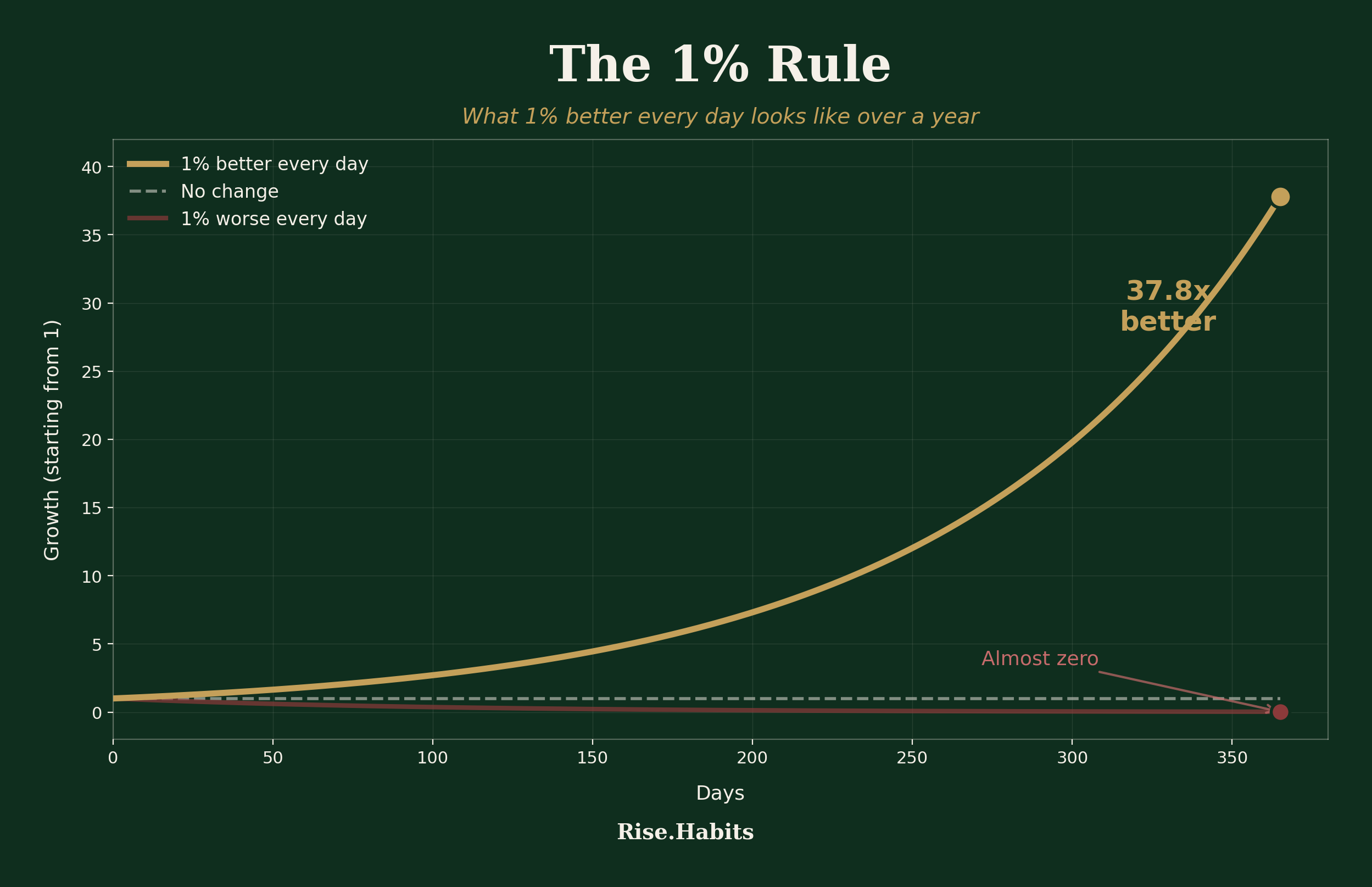
Get 1% better every day for a year. By the end, you're not 365% better. You're 37 times better. Compounding does that. It quietly stacks one decision on top of the next until what looked tiny at the start becomes the thing that defines your life.
Now flip it. Get 1% worse every day for a year. You don't lose 365%. You lose nearly everything. Down to almost zero.
That's how identity actually shifts. Not in moments. In the slow accumulation of choices that nobody else is watching you make.
Why we miss it
The reason 1% feels pointless is because you can't see it on day one. Or day ten. Or even day thirty.
The gym session you did today does nothing visible. Eating the right thing tonight doesn't change the way you look tomorrow. Reading ten pages of a book is not going to make you a different person by next week.
That's the trick. The results are invisible until they aren't. And by the time they show up, you've already done the work.
This is also why most people quit. They expect to see the curve early. The curve doesn't show up early. It shows up late, all at once, and only for the people still doing the work when it does.
The honest part
You don't need a perfect day. You need a streak of okay ones.
The version of you in twelve months isn't built by motivation. It's built by what you did on the days you didn't feel like doing anything. Showing up to log the habit. Showing up to put the trainers on. Showing up to do the smallest possible version of the thing instead of nothing.
That's the whole game.
What to actually do
Pick one thing. Just one. Not five. Not ten.
Make it small enough that you can't fail. Drink one glass of water in the morning. Read one page. Do five press ups. Whatever it is, make it so small that skipping it feels stupid.
Then do it tomorrow. And the day after. And the day after that.
You'll be amazed at where you are in a year.
That's the 1% rule. It isn't a trick. It's a willingness to keep going when nothing seems to be happening.
Because something is. You just can't see it yet.
This is why we built Rise.Habits
The hardest part of getting 1% better every day isn't the doing. It's the remembering. The keeping track. The proof that you actually showed up on the days you didn't feel like it.
That's the whole reason Rise.Habits exists.
It's a habit tracker built for people who are serious about the long game. Not a subscription. Not a tracker that buries you in features. Just a clean, simple way to log the small things every day and watch the streak build.
You open it in the morning. You tick the habits as you go. You see your streaks compound. Over time you stop relying on motivation and start relying on the system. Because that's the thing motivation doesn't tell you; discipline is just a system you trusted long enough to work.
Free for up to four habits. £5.99 one time unlocks everything forever. No subscription, no ads, no tracking. Yours forever.
Because the version of you in twelve months is already being built. We just want to make sure you don't lose count.
